 Poll Position
: run a country, one month at a time
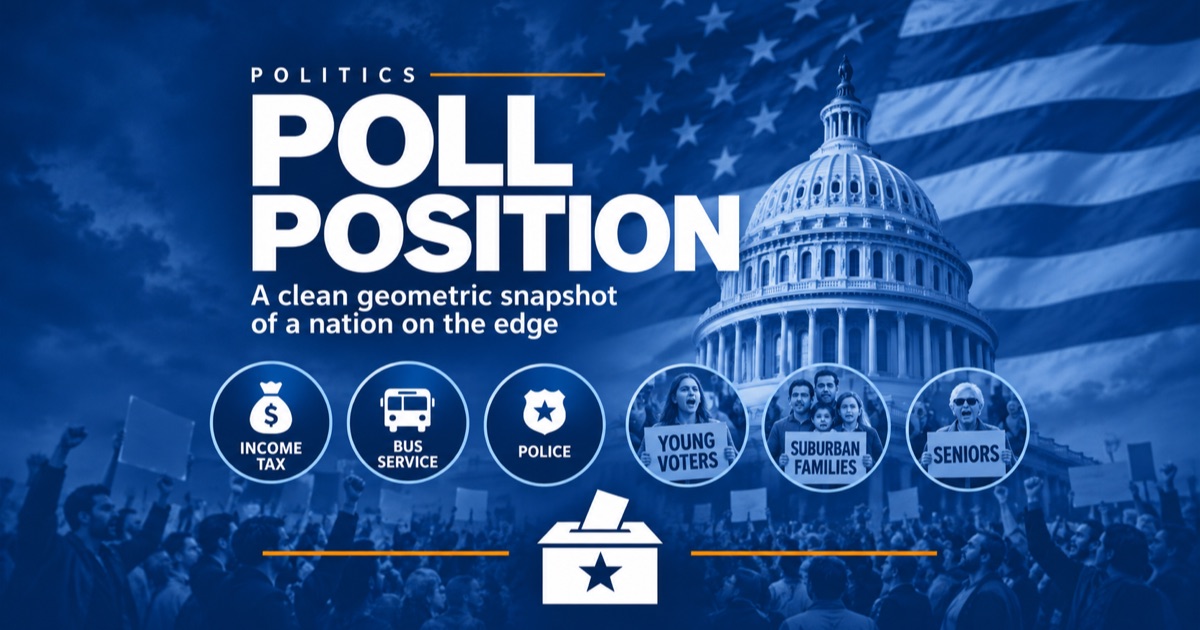
A free political and economic simulation for your desktop browser. Set taxes, laws and spending, watch them ripple through the economy and society, and find out whether the voters re-elect you.
What you do
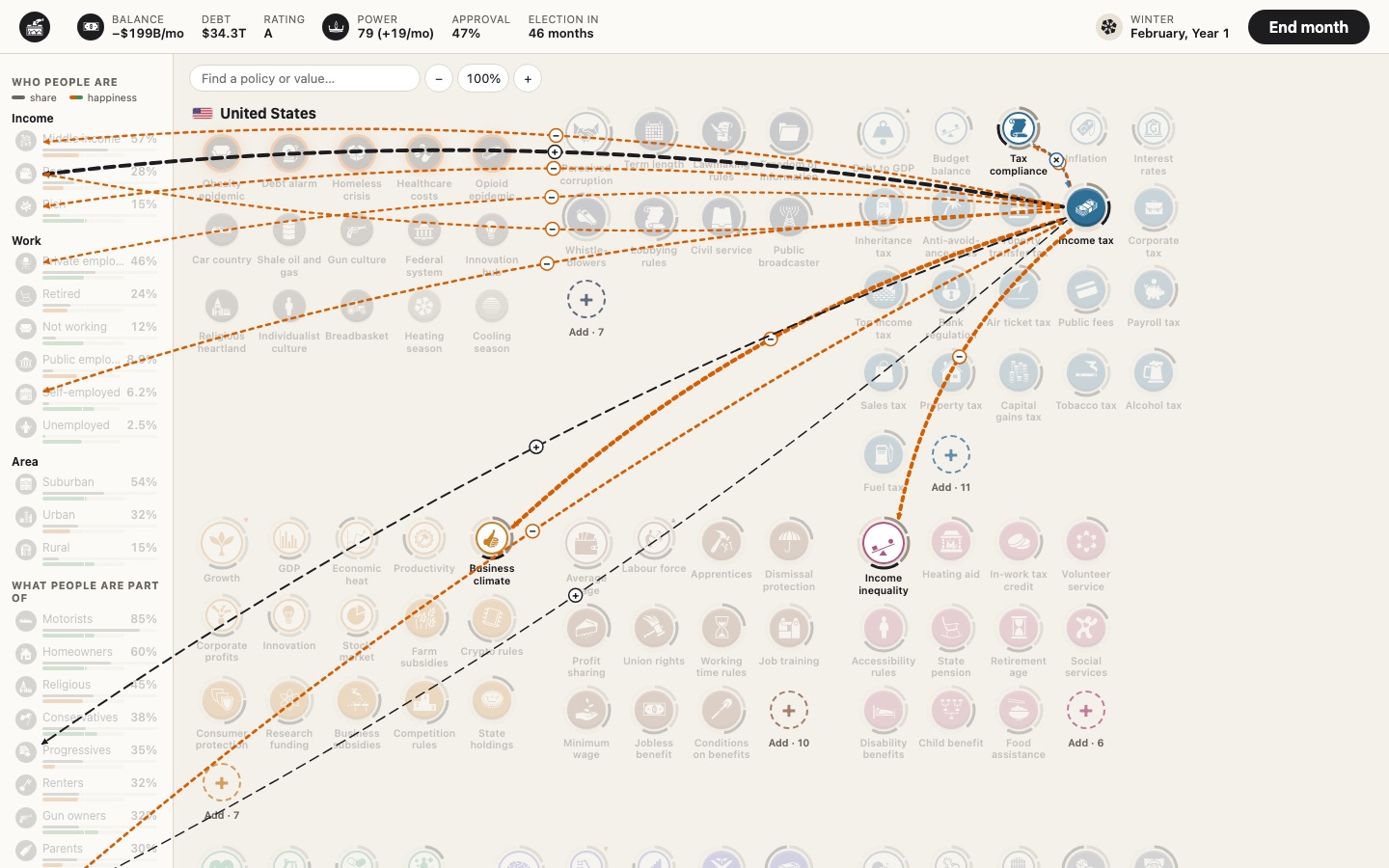
You lead the government of a country. You don't press buttons that make things happen: you set policies, about 200 of them, from income tax and the minimum wage to police, bus service and pensions. A web of cause and effect turns them into growth, jobs, crime, health, debt and, in the end, votes. Every round icon on the screen is a policy, a value or a situation: hover one to see what it influences, click it to see why it is where it is.
The game runs one month at a time. You earn Power every month and spend it on changes, which take effect at once and are final; the country reacts over the following months. After each month a summary shows what happened: situations building up, changes taking effect and how every ministry did.
At the end of the term comes the election, a popular vote: you need 50% to govern on, and 55% or more is a landslide. Lose the election or let the country default on its debt, and the game ends. There are no term limits.
Three countries
The United States and Germany, with terms of four years, and France, with five. Each starts from its real situation, with figures from the open data of the World Bank, the IMF and the OECD: its own budget, debt and credit rating, its own voters, lobbies and traits, and its own names for the ministries.
The United States are open to everyone. Germany and France open with one click on “Unlock without donating” in the country picker: the game runs on the honour system, and donations simply keep it going.
What you deal with
- Budget and debt. The top bar shows the balance, the debt and the credit rating, from D to AAA. Lenders watch the deficit, the rating is reviewed every six months, and a country that can't carry its interest defaults.
- Taxes. All of them are in Finance: income tax with a basic and a top rate, corporate, sales, payroll, property, capital gains and wealth taxes, and separate taxes on fuel, tobacco, alcohol and cannabis.
- Twelve ministries, from Finance and Labour to Health, Housing, Transport and Foreign & Defence, each with a catalog of policies that aren't in place yet.
- Voters. People belong to groups by income, work and where they live (poor or rich, retired or self-employed, urban or rural), and to groups they're part of, such as parents, renters, motorists or union members. Every adult averages the happiness of their groups, adds a leaning of their own and votes for you above 50%.
- Situations, bad and good: a debt alarm, a crime wave, a housing bubble or a pension crunch, but also full employment, a tech boom or a tourism boom. The few closest to starting can be seen building up; the rest come as a surprise.
- Lobbies offer deals: Power now for a policy change they want, which then stays locked for a year, at the price of favouritism and perceived corruption.
- Demands and promises. Groups make demands with a deadline, which pay Power if you meet them. At the start of a term you can make up to three promises; at the election, each one kept adds to your vote and each one broken takes away.
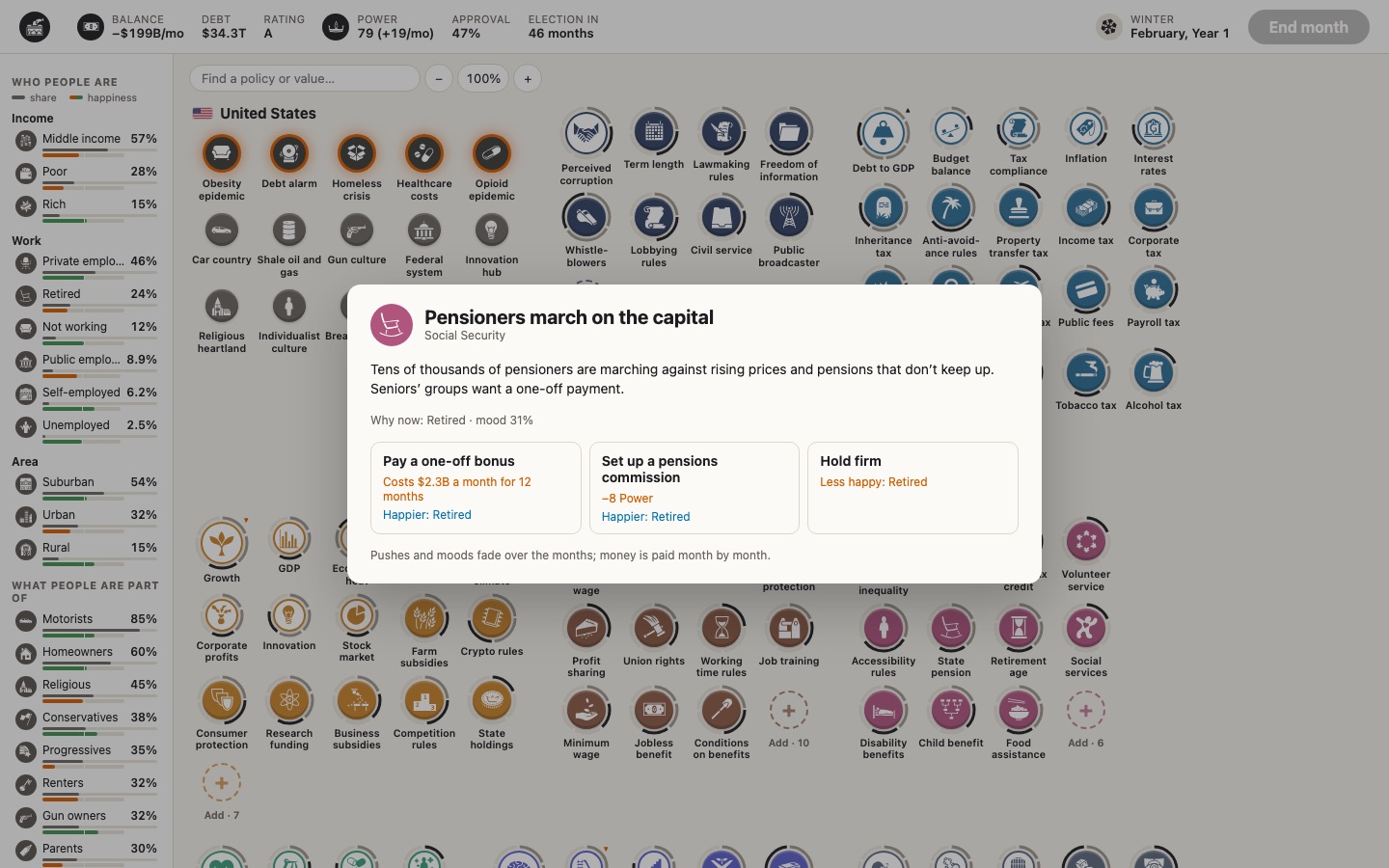
- Event cards: dilemmas such as a big factory closing or nurses threatening to strike. They come from the state of the country and the season, never from chance.
- The term review: after every term, who gained and who lost, the country then and now, and what you changed.
Tips and tricks
- Try before you pay. Move a slider to preview what a change would do, and reset it if you don't like it. Once paid, a change is final, and changing back costs Power again.
- Voters move slowly. One point of happiness across every group is worth about two and a half points of the vote. Many small, well-aimed changes beat one big gamble.
- Losses hurt more than gains. A tax rise angers people about three times as much as the same cut pleases them.
- Watch the deficit. Big deficits make lenders nervous, the credit rating moves one step at a time, and rising interest eats into everything else. The United States start with a large deficit and a debt alarm.
- No single policy ends a situation. Open it to see what drives it, and pull several levers at once.
- Plan years ahead. Houses, prisons and pension reforms take years to pay off. Build up buses and trains before you raise the fuel tax.
- Lobby deals cost more than they seem. The Power comes at once, but so do favouritism and perceived corruption, and the policy is locked for a year. Turn a lobby down and it waits longer before its next offer.
- Meet demands when you can. A demand met pays Power and lifts the group's mood; one missed lowers it.
- Read the arrows. An arrow marked + raises, one marked − lowers, a thicker one does more, × multiplies, and blue arrows carry money. Indices read 100 for a typical rich democracy.
- Use the keyboard. Enter ends the month, and Enter again closes the summary.
How it was made
- Real numbers. Starting values come from the open data of the World Bank, the IMF and the OECD, in real units: money, percentages, years. Each country starts close to its real figures.
- No dice. Crises grow out of the model, so you can see them coming; lobbies and event cards follow fixed rules. The same choices lead to the same results.
- Policies are the only lever. There are no speeches, ad campaigns or scandals to manage: you govern by what you change.
- Changes take effect at once. Not realistic, but more fun to play: you see what you did straight away, and the country catches up over the following months.
- Everything explains itself. Every value shows what moves it and by how much.
- Arrows show direction, not good or bad. Whether more of something is good depends on your own views, so arrows only say up or down. Their default colours, black and orange, are easy to tell apart for colour-blind players.
- A world in the background. Exports follow how competitive the country is, people come and go and a few rare shocks strike from abroad, as numbers rather than diplomacy: it's a game, and corners are cut where that keeps it fun.
- Fictional actors. No real politicians, parties or lobby organisations.
- Balance tested by machine. A sweep tries every single change and a bot plays whole terms, to check that there are many good answers and no perfect one.
- All content is data. Every policy, value, group, situation and event is a data file, so balancing never needs a change to the code, and all of it was written for this game.
- No accounts, no server. The game runs and saves in your browser.
Questions and answers
Is Poll Position free?
Yes. It is free for private use, with nothing to buy. If you enjoy it, you can buy me a coffee.
What do I need to play?
A desktop or laptop computer with a current browser such as Chrome, Firefox, Edge or Safari. There is nothing to install. The game is made for a mouse and a large screen; phones and tablets aren't supported.
How does saving work?
Automatically, after every month and every policy change, in your browser on this device. Open the game again in the same browser and it continues where you left off. Clearing cookies and site data deletes the save, private windows forget it, and other browsers and devices keep their own games.
Which languages are there?
English, Spanish, German, French, Russian, Portuguese and Indonesian. The game follows your browser's language; you can switch in the menu at any time, and your game carries on.
Does the game track me?
Only if you allow it. The game may ask once whether it can count you as a player with Google Analytics, and you can change your answer in the settings at any time. The details are in the privacy policy, also in the game's menu.
Can I win?
There is no final victory: you govern for as long as the voters re-elect you and the country can pay its debts. After every term, the review shows how the country changed under you.
Who makes Poll Position?
Luca Bosch. Feedback on the balance or the policies is welcome: write it in the message with your coffee.
Who made the music, sounds and icons?
The music is by Kevin MacLeod (incompetech.com, CC BY 4.0), the sounds by Kenney (CC0) and the icons come from game-icons.net (CC BY 3.0), most of them by Delapouite and Lorc. The full credits are in the game's menu.